VisheshVerse
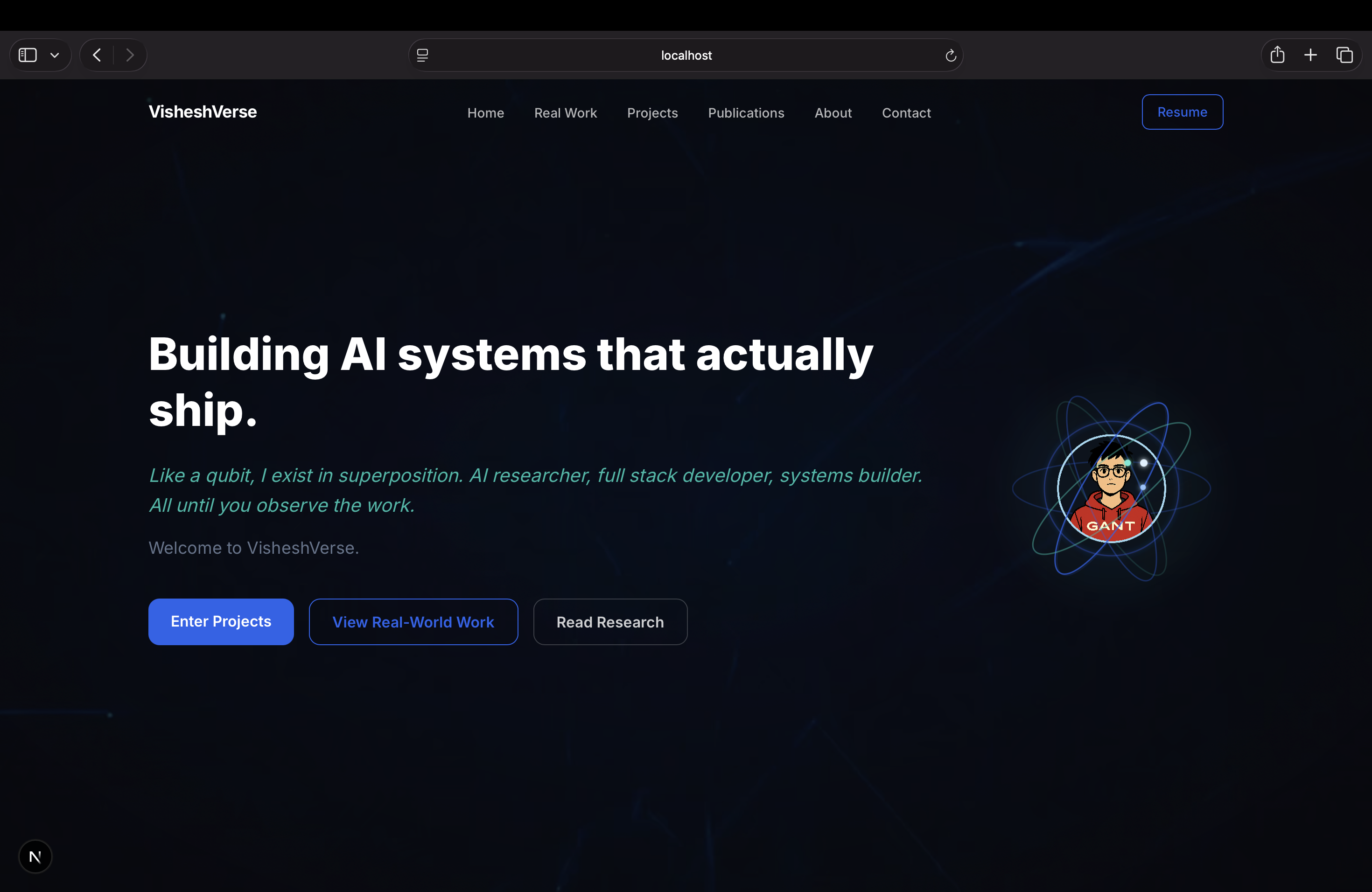
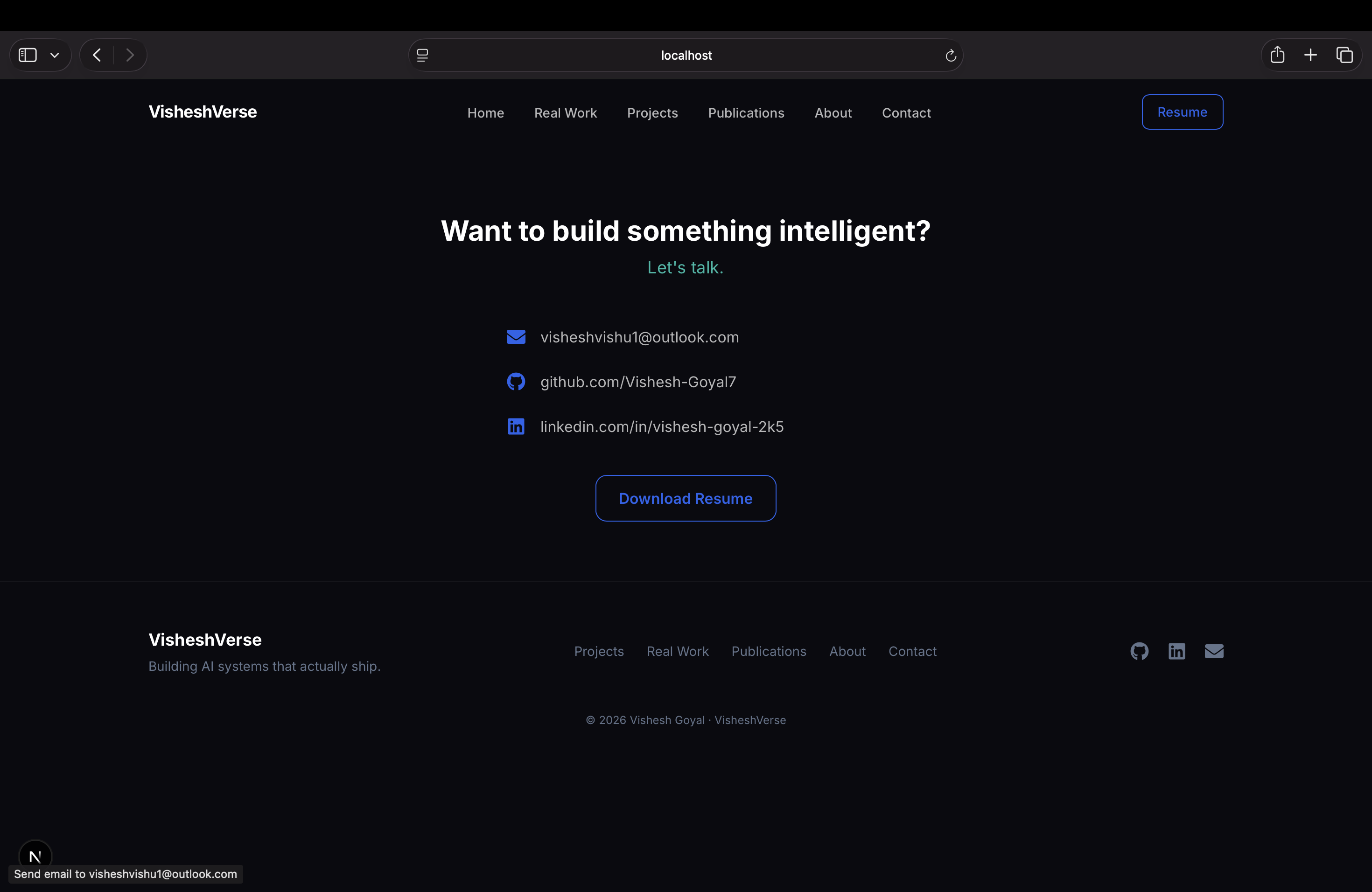
The portfolio you're reading this on. A production-grade Next.js platform with a qubit animation identity, Google Sheets CMS, MongoDB fallback cache, and full SEO infrastructure. Built from scratch, shipped to production.
Role: Solo Builder & Designer : architecture, design system, animation system, CMS integration, SEO infrastructure, data layer, full-stack deployment
Overview
VisheshVerse is not a template. It is a fully custom-designed and engineered personal brand platform built to communicate one thing clearly: this person ships AI systems that actually work. Every technical decision, from the qubit-inspired animation system to the write-through MongoDB cache to the multi-page SEO architecture, was made deliberately. The site you are reading right now is itself a deployed project, maintained in production, and representative of the same engineering standards applied to every other piece of work on this page.
The Problem
Most developer portfolios are either over-designed Dribbble experiments that look good and say nothing, or under-designed resume exports that say everything and feel like nothing. Neither converts. The real problem is that a portfolio for an AI engineer needs to simultaneously convince a recruiter in 3 seconds and satisfy a senior engineer who reads every word. It needs to be visually distinctive, technically credible, SEO-optimised for the right keywords, and fast enough to score well on Core Web Vitals. It also needs to be maintainable, a portfolio that requires a code deployment every time a new project is added is a portfolio that stops getting updated. VisheshVerse was built to solve all of these problems at once.
How It Was Built
No existing portfolio template communicates what needs to be communicated here. Templates are generic by definition. A portfolio for someone with IEEE publications, deployed AI systems, and a quantum cryptography research background needs a visual identity and a content architecture that reflects that — not a theme someone else designed for a generic creative professional. VisheshVerse was designed around a single brand idea: the universe of Vishesh. Not a cosmic space theme — a futuristic AI operating system. The kind of interface that says "this person builds serious systems" before a single word is read.
The Design System
The site operates on a deliberate dark-light alternation rhythm. Dark hero sections with video backgrounds and quantum glow create atmosphere. Light sections for certifications, publications, and contact provide visual breathing room. Neither section style is used arbitrarily — the alternation is a design decision baked into the component architecture.
The colour palette is precise.
| Token | Value | Usage |
|---|---|---|
| Dark background | #0A0A0F | Hero, project, and accent sections |
| Primary blue | #2563EB | Buttons, links, orbital rings, qubit particle |
| Accent teal | #14B8A6 | Secondary highlights, impact callouts, outer glow |
Every colour token is defined as a CSS variable and consumed consistently across every component. There are no one-off colour decisions anywhere in the codebase.
Typography uses Inter for all UI text and JetBrains Mono for tech stack badges and code elements, loaded via `next/font` for zero render-blocking font requests.
The Qubit Animation System
The centrepiece identity animation was inspired directly by the quantum cryptography research published as part of this portfolio. A qubit exists in superposition — it is not a 0 or a 1 until observed.
"Like a qubit, I exist in superposition — until you observe the work."
The animation makes that metaphor visual.
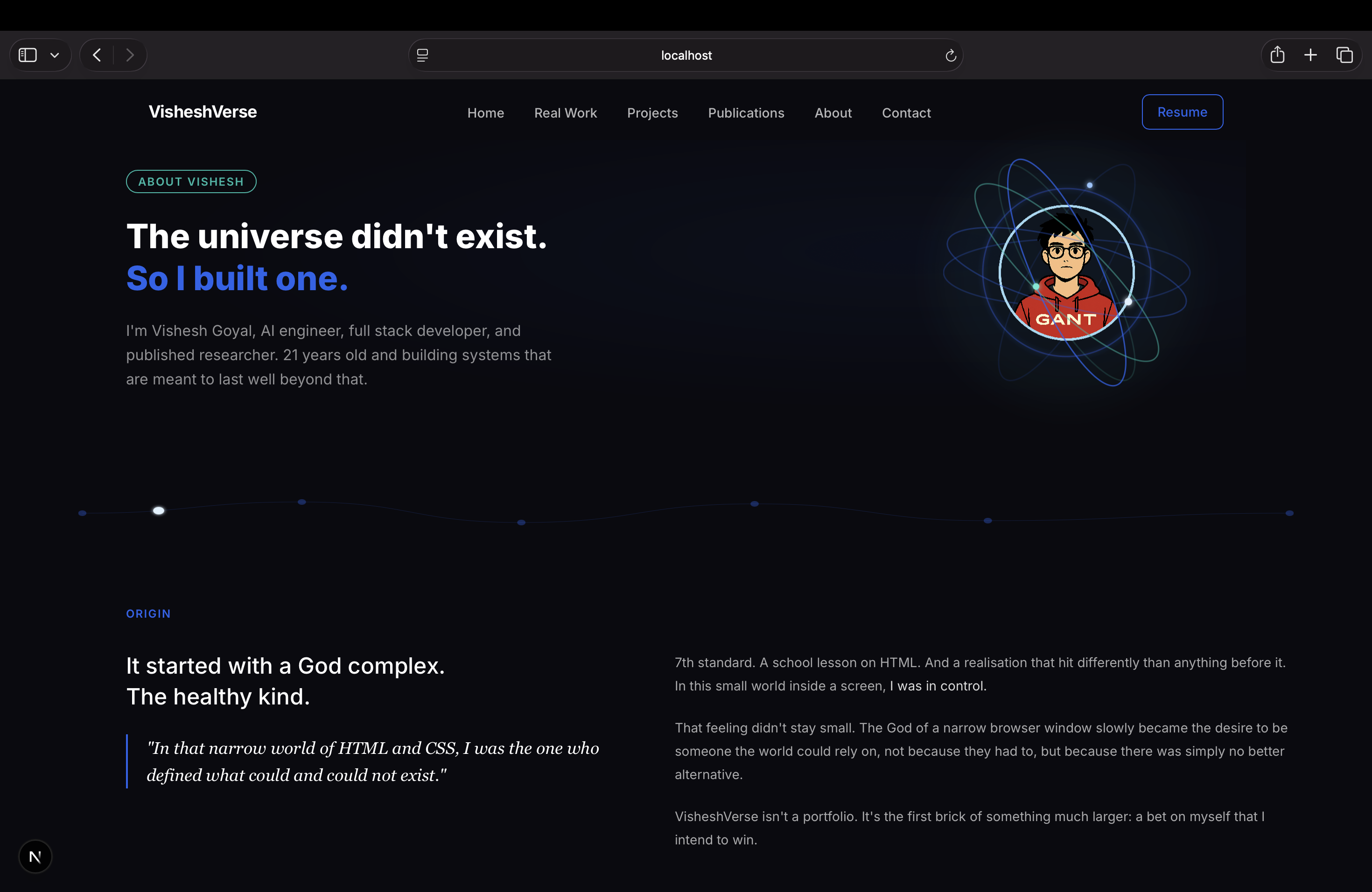
The Qubit Orb
The Qubit Orb is a three-layer CSS 3D component.
| Layer | What It Is |
|---|---|
| 1 | Radial gradient glow in accent teal — atmosphere |
| 2 | Sphere clipping the profile photo inside a circle |
| 3 | Three SVG orbital rings at deliberately desynchronised speeds |
The rings rotate at 6 seconds, 9 seconds, and 14 seconds — they never sync, so the orb always feels alive rather than mechanical. A small glowing particle travels along one orbital ring using CSS `offset-path` animation.
The SVG Qubit Dividers
SVG Qubit Dividers replace standard horizontal rules between every section. Each divider is a neural network circuit pattern — connected nodes with low-opacity lines and a travelling blue particle that moves left to right in 3.5 seconds, infinitely.
All animations are CSS and SVG-first. No Three.js. No Canvas for decorative elements. Framer Motion is used only for scroll-triggered section reveals. Lighthouse performance stays above 85.
The CMS Architecture
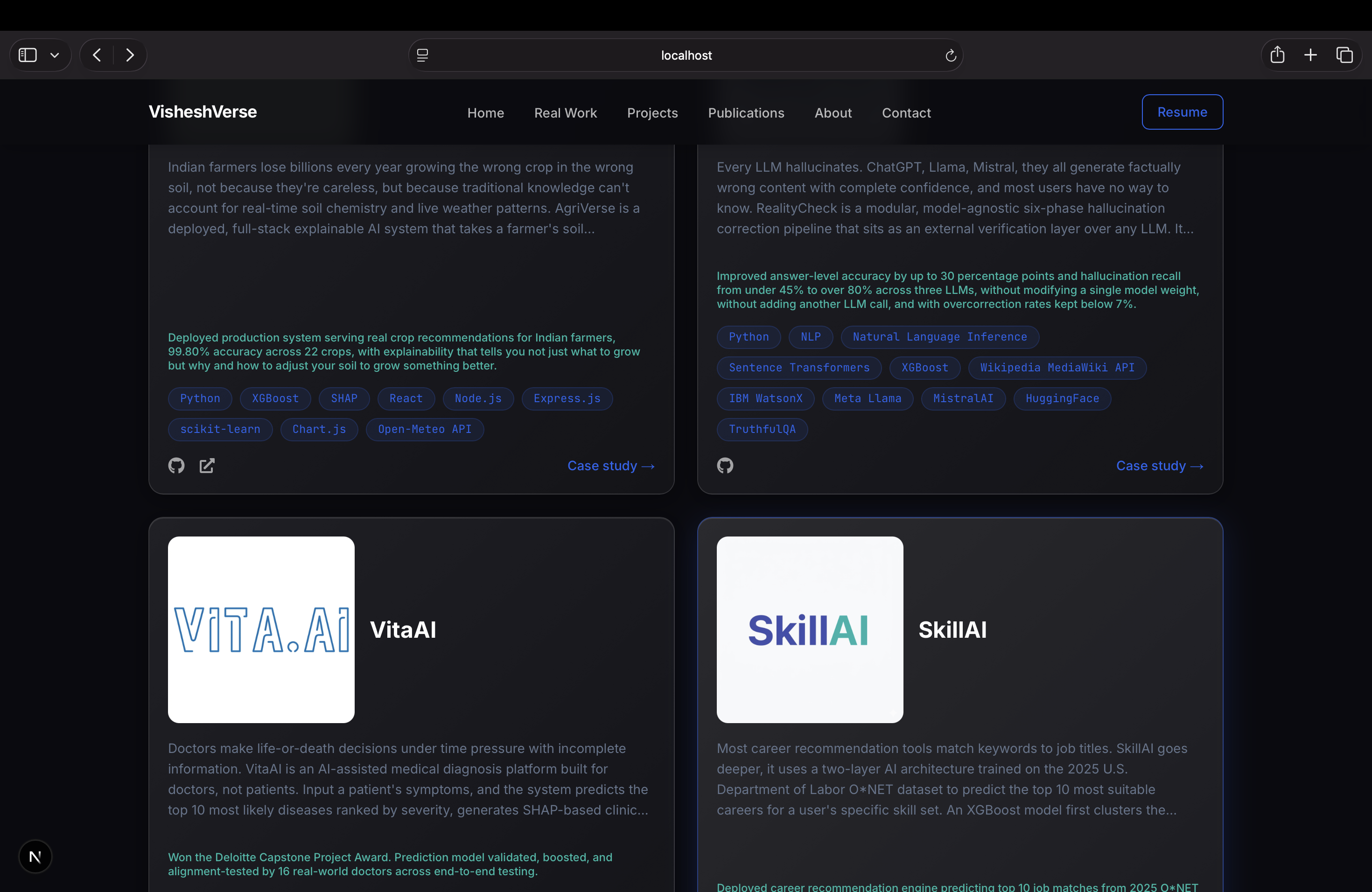
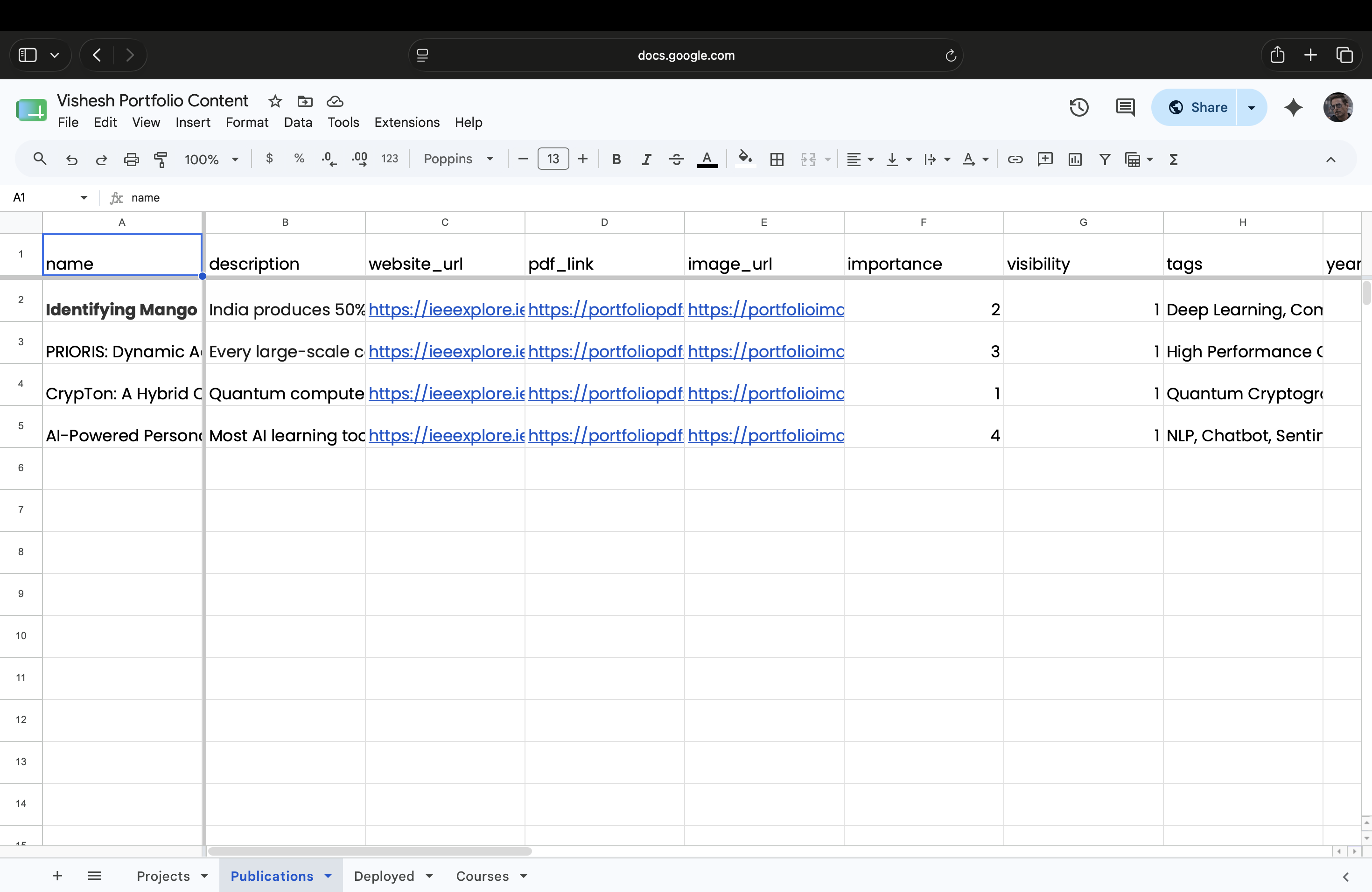
Every piece of content on VisheshVerse — projects, publications, deployed work, tech stack, courses — is managed through Google Sheets. No code deployment is required to add a new project, update an impact statement, or change the order items appear.
The data layer uses a write-through cache pattern.
| Step | What Happens |
|---|---|
| Normal path | ISR revalidation (3600s) fetches fresh data from Google Sheets, simultaneously writes to MongoDB |
| Fallback path | If Sheets API fails, MongoDB serves the last known good data — the user never knows |
This is the same resilience pattern used in production data systems, applied to a portfolio site because the same engineering standards apply regardless of scale. All images and assets are served from AWS S3.
The SEO Infrastructure
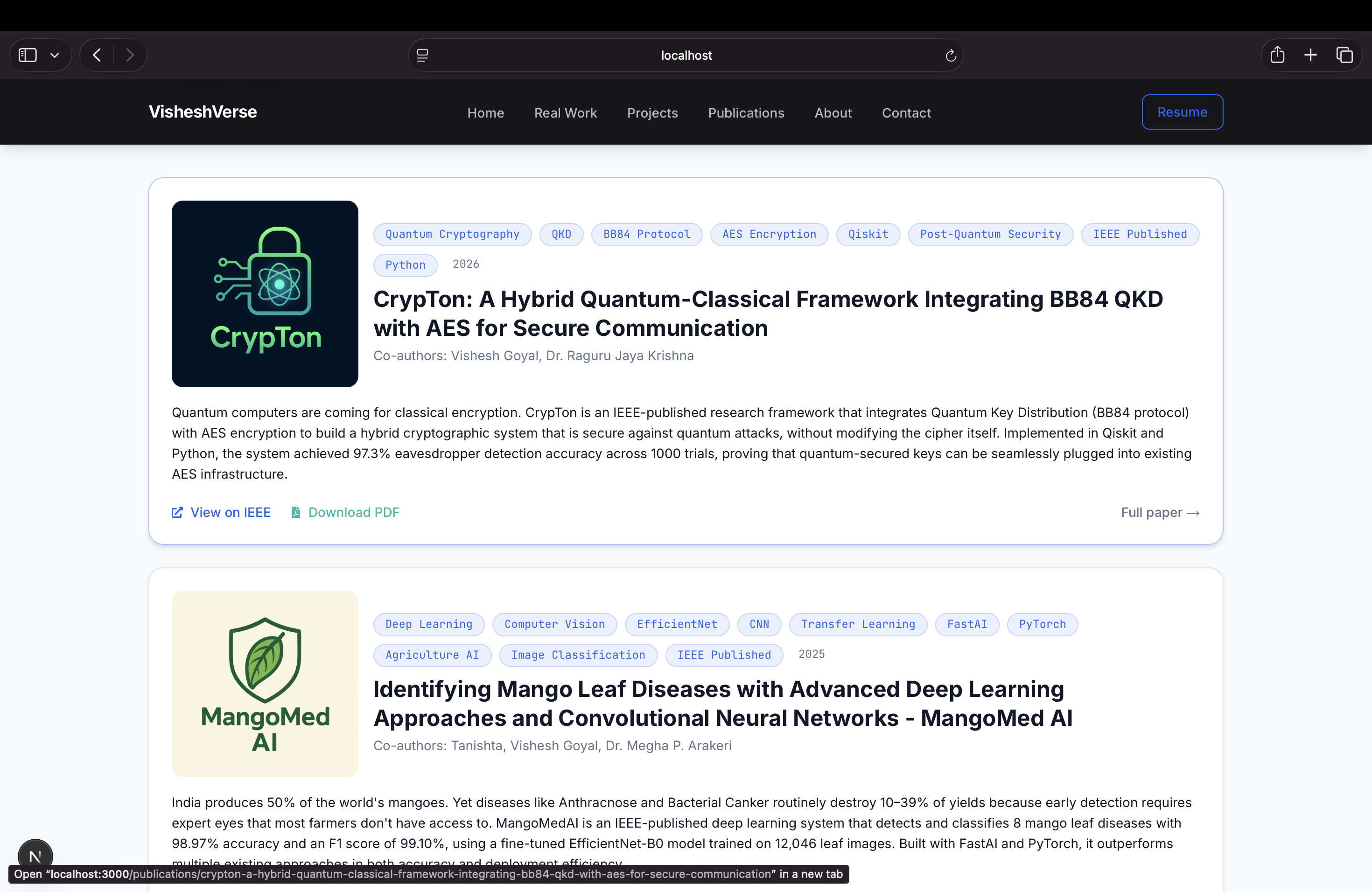
A single-page portfolio is a single SEO target. Every project, publication, and deployed build on VisheshVerse has its own crawlable route with:
A unique title tag, meta description, canonical URL, Open Graph image, Twitter card metadata, and JSON-LD structured data.
The sitemap is dynamically generated via a Next.js `app/sitemap.ts` route (always reflecting live Sheets data) and submitted to Google Search Console.
The result: individual projects are indexable as standalone pages. A recruiter searching "quantum key distribution student portfolio India" or "explainable AI crop recommendation system" lands directly on the relevant project page, not the homepage.
Multi-Page Route Architecture
The site has full multi-page routing across 8 primary routes with full dynamic slug support.
| Route | Type |
|---|---|
| `/projects`, `/projects/[slug]` | Static generation + ISR |
| `/deployed`, `/deployed/[slug]` | Static generation + ISR |
| `/publications`, `/publications/[slug]` | Static generation + ISR |
| `/about`, `/contact` | Static |
Each dynamic route uses `generateStaticParams` for static generation at build time and ISR for revalidation. This is the architecture that makes the SEO strategy possible — a single-page portfolio with anchor links is one indexable blob. VisheshVerse is a fully crawlable, multi-page application.
The Meta Point
The site you are reading this on was planned, designed, architected, and built with the same rigour applied to every other project in this portfolio. It has a research-backed visual identity, a production data architecture, a full SEO infrastructure, and an animation system rooted in published academic work.
It is not a showcase of what can be built. It is an example of it.
Results & Impact
A portfolio that is itself proof of the work it contains. Production-deployed, SEO-optimised, CMS-driven, and built to the same engineering standard as every other project on it.